What Christians get wrong about Lent (and why the truth is so much better)

Traditionally, one of the main themes of Lent has been repentance.

To the post/un-religious, that word is a bit of a red flag, with all its connotations of sin and shame and self-flagellation. Not very attractive, and certainly not something you would want to spend reflecting on for weeks on end.

Fortunately, despite what many of us grew up hearing in church, that’s not what repentance means.

There are two words in the Bible that are translated as ‘repent’: the Hebrew teshuva and the Greek metanoia.

Teshuvah means ‘return’, while metanoia means ‘to change one’s mind/heart/inner being.’

Teshuvah is the act of returning to our souls – to the ways things are meant to be. It is a coming home to our own aliveness.

Metanoia is a declaration of agency. It says that we can grow, shift, make something new. It declares that the status quo can be broken; that change is possible.

So Lent is no grim season of religious reckoning. It is a beautifully hopeful time.

This Lent, may you return to your soul. May you seek out and find whatever it is that makes you feel most alive. May you be released from the grip of anything that is keeping you from your human-ness.

This Lent, may you take hold of possibility. May you awaken to your agency and creativity. And may you receive the blessing of imagination: the belief that we can make a new world.

Gideon

Photo credit: Pexels
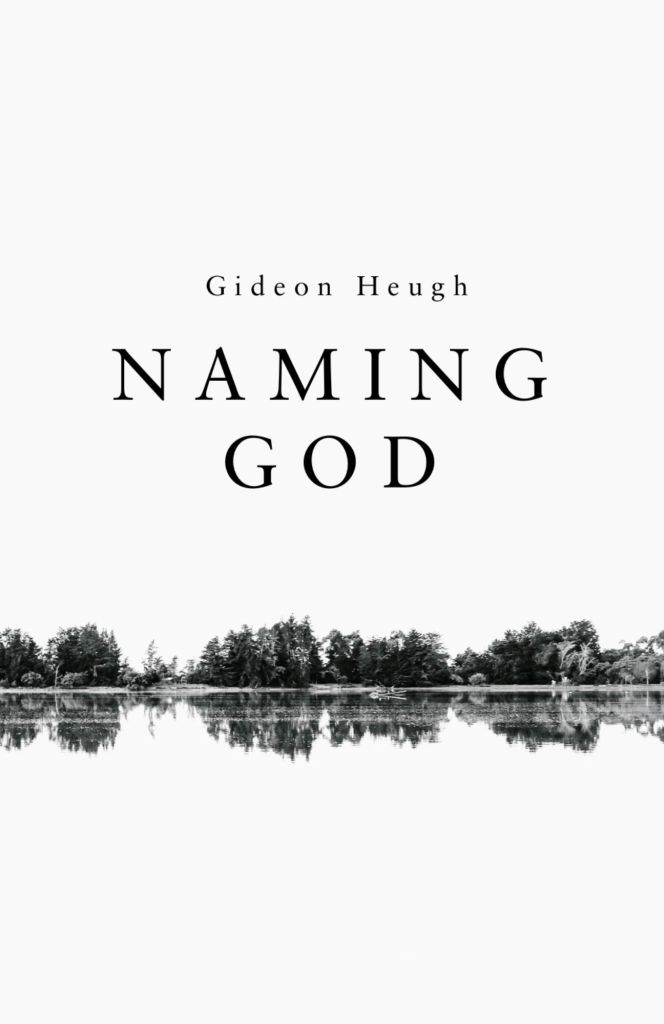
New book out now!

Naming God is out now.

This is the final instalment in the trilogy that began with Devastating Beauty and Rumours of Light – continuing that journey; developing and refining the dreams and ideas in those books. I’m hoping this sticks the landing in the same way that Return of the King/Jedi and Toy Story 3 did.

I can see my own growth as a poet and person through the books. This is definitely the most mature of the three. By which I mean it reaches for the deepest places; it lets go of the most of what needs letting go; it’s the most authentic reflection of me as an artist and human.

And of course there’s plenty of wonder. And mischief. And longing. And grief. And love. And hope.

I can’t begin to describe what this book means to me, or how excited I am that you’ll soon get to read it.

You can get your copy here.

Much love and gratitude,
Gideon Heugh

Naming God

‘God is the hope you set aside, nonetheless following you.’
Photo: Aliis Sinisalu/Unsplash

Naming God

God is death, and what death becomes.

God is the pale reverie of morning—
light growing in response to itself.

God is the sobs of the young lover,
the dust flung off by swirling galaxies,
the twinkle in the eye of the aging dreamer.

God is the wonder that aches into you
when you lift your eyes towards the stars;
the contentment welling up inside of you
as you lower your hands into the soil.

The turn of the seasons, the ripening
and the decay, the wild laughter and the frightening tears
and the sorrow that’s kissed by a smile.

God is the hope that you set aside,
nonetheless following you.

God is the dark space in the margins of cathedrals,
the breeze searching the quiet meadow,
the question that’s lurking
beneath an easy answer.

God is the slow motions of grief;
love; its gentle tenacities.

God is the weeping space
where the trees used to be.
God is the anger of the colonised.
God is the dread snarl of reckoning.

God is the long miracle.

God is the artist who almost gave up;
the secret that only disappointment can reveal.

God is the fire
painting great shadows
of our smallness.

God is whatever it is
that made us think we should dance.

God is the purpose of the worm,
the song of the bird that eats it,
the wiry limbs of the fox
that kills the bird the fox
whose body will be taken by the worm.

God is the refusal to be cynical,
the people who decide to help,
the long-buried seed touched
by a whisper of warmth.

God is the unfathomability of meaning;
the knowledge that it means something beautiful
anyway.

God is simplicity itself.

God is what pulls you towards other souls,
the quivering web of existence,
the first and the last gasps
of creation.


Gideon Heugh

Waking early, teshuvah

Waking early, teshuvah

I know that I need more sleep,
far more sleep than this,
but I also know that I need to change my life.

In these day-shy moments,
passing ships with our dreams.
we are more intimate with our subconscious.
Perhaps at this thin hour
it is quiet enough to hear my soul—
so often drowned out
by my strange need to be useful.

Perhaps the smell of dew
will bring God down from the clouds
where we so zealously put him to work.

I know that I need more sleep,
but the songs that greet the first breath of day
sound like repentance.
So what of bleary eyes
if it lets me remember something
about grace?

Angels are more interested in our yearnings
than our ambitions.
Take those deeper sighs
and cast them upon morning’s altar
and you might find that you are not alone.

Do not be troubled by this stirring,
these aches of divinity
returning your blood to meaning.

I know that I need more sleep,
but during the day
I am too busy asking
to receive,
too busy thinking
to be thoughtful,
too busy trying to make a living
to remember to be alive.

I am here now, heart awash
with dawn’s soft clarity.

The mercy of this world’s abundance.
I will go and change my life.


We are one week into Elul – the last month in the Jewish year.

It is a month of reflection, in which we prepare for Rosh Hashanah (new year) and the Days of Awe that culminate in Yom Kippur – the Day of Atonement.

This is a season of ‘teshuvah’.

Teshuvah is usually translated as repentance, but it literally means ‘return’.

Return to what really matters.
Return to beauty.
Return to simplicity.
Return to family and friendship and community.
Return to kindness.
Return to goodness.
Return to creativity and play.
Return to honesty.
Return to self-compassion.
Return to nature.
Return to love.
Return to all the things that make our souls sing and contribute to tikkun olam – the repair of the world.

We all stray from these things sometimes. And it’s good to have reminders to come back.

Gideon Heugh

Reflection: life is so much audacity

Photo credit: István Szitás/Pexels

Dare to believe. And when believing lets you down, and after you have grieved, believe in something bigger. Keep going until all you have faith in is life, the universe, everything.

Love. And when love lets you down, and after you have grieved, take your love further. Keep expanding the circle of your soul until all you love is life, the universe, everything.

They will convince you to be cynical. They will convince you to close up, to tighten your fist. They will convince you that life isn’t worth the risk. Take the leap anyway. See for yourself.


This came out of a bleak mood today. An entreaty to cast our nets of hallowing wider, even as so much of the world seems hell-bent on getting us to shrink into narrower perceptions.

I will guard my heart. I will guard it against smallness; hardness. I will set boundaries within a soul that is boundless. I will thrill in a spring-spell of bloomings even knowing that a season will come to shrivel it all. Rot on the ground makes for a more hopeful future.

Life is so much audacity. It is holding grief and saying ‘this too’. It is knowing the endless surprise we have in store.

Bleak moods end. The primroses and celandines and wren-songs are still there. Until they won’t be. Until they will be again.

Believe; love; but more than you know.

Gideon Heugh

Room to breathe

‘Those were the broad days! … And the
smell of the air! I used to spend a week
just breathing.’

Treebeard, from The Lord of the Rings: The Two Towers

You must always have something to do. You must always fill every nook and cranny with fuss and bustle and busyness. Or, failing that, with the screenful fug of distraction. Don’t you ever dare take time to reflect. Don’t you ever dare give yourself room to breathe. Don’t you ever dare be idle, or let the dust settle, or daydream. And, oh, you want to complain about your wellbeing?

We have been conditioned to fear spaciousness. Far better to distract ourselves than feel deeply. Far easier to wash ourselves in the endless stream of content than confront the really real.

Yet every week that goes by without true rest, the toxins of toil build up in our souls. Every week that goes by in which we do not reach shakingly into our feelings, the un-aliveness seeps further into our bones.

For the sake of our souls, we have to stop. For the sake of our being, we must revolt against the tyranny of ‘do’ and ‘distract’ and instead build a thousand heavens of ‘be’.

We must cultivate spaciousness; re-learn doing nothing. Not occasionally. Not as a treat. Not as a last resort in response to burnout. It has to be a rhythm. Deeply embedded. Never avoided. Regular and non-negotiable. For the longer we go without, the less real, the less human we become.

So may the broad days find you again.
May the savour of larger, greener airs suffuse you.
And may you spend a week just breathing.

Gideon Heugh

This reflection was taken from my ‘Lord of the Rings at Lent’ devotional series. Follow me on Instagram @gideon.heugh for more.

Sabbath poem

Pixabay

Sabbath poem

Blessed are the ones who say no.
Blessed are the ones who think that living
is ambition enough.
Blessed are the simple, the gentle, the unsung.

Heaven tastes bitter to the overachiever.
It belongs to the children, and to the ones
who despite the gnawing aspiration of years
have not forgotten the truth.

Blessed are the ones who walk slowly,
who would get distracted by a daisy,
who would rather climb a tree than a ladder.

Gideon Heugh

Lines for an early morning, March

Wojciech Święch/Unsplash

The dawn never hurries; it is too sure of itself.

Lines for an early morning, March

You wake up anxious. Sleep was a respite,
but now your worries are pouring down your throat.
Somehow you breathe. Somehow you get out of bed
and make coffee. You try not to face the day,
but instead go to your room and close the door.

The year is insistent in its turning;
already the world can feel the nudge of spring.
Six a.m and you dare to pull back the curtain.
There is a glow on the horizon.
You switch off your light, clutch your warm cup,
stare into the repenting dark.

The dawn never hurries; it is too sure of itself.
You open the window, despite the cold,
and lyric of blackbird and robin pours in. The sky
slowly weaves a story. You may struggle to agree with it,
but you cannot prevent a word like beautiful
from seeping into your blood. The tears are from pain,
yes, but something else besides.
You woke up anxious. You face the day.

Gideon Heugh

Meditations on the January blues

Meditations on the January blues

The earth and the sky declare it.
Wonder does not have to be a pursuit.
Meaning is not a treasure
to be snatched at.

The trees do not stand there for so long
for nothing. When the song thrush sings
it seems to do so with its whole body,
and more besides.

I peeked through the curtain last night
and Jupiter and the stars were just… there.

Science tells us that acts of kindness
are a better treatment for depression than therapy.
You think we would have figured it out by now.
So many centuries since Galileo,
but still we misplace the revolution.

To be awed is a choice.
Are we willing to look around?

An Instagram post speaks
of unleashing the divine within. Fine, but
you could be empowered like nothing else
and still be lonely as hell.

Love is a web. A thread on its own
will do nothing.

Love is the leap of faith
that shows the chasm was never really there.
If only we believed in entanglement.
Instead we are sold self care.

How different are you really from the tree,
or the song thrush? Assume nothing.

Put up a wall and you are less alive.
The first shall be last perhaps
because they’ve left everyone else behind.

Gideon Heugh

Christmas carol

Christmas carol

Awake now my love—
the bells of life
are sounding through the frost.
Awake now my love—
the lowly are telling stories
of bright strangers in the hills.
Awake now my love—
the divine is singing longingly
of what it means to be you.

Make now your humble door—
the star-drunk pilgrims
are not looking for a palace.
Gather now the crowns
of bloodberry and green—
the Christ smells of sap
and wet bonfire smoke.
Ready now your journey
from the desolate before—
the mother of the new is in labour;
awake now, and be born.

Gideon Heugh